Architecture
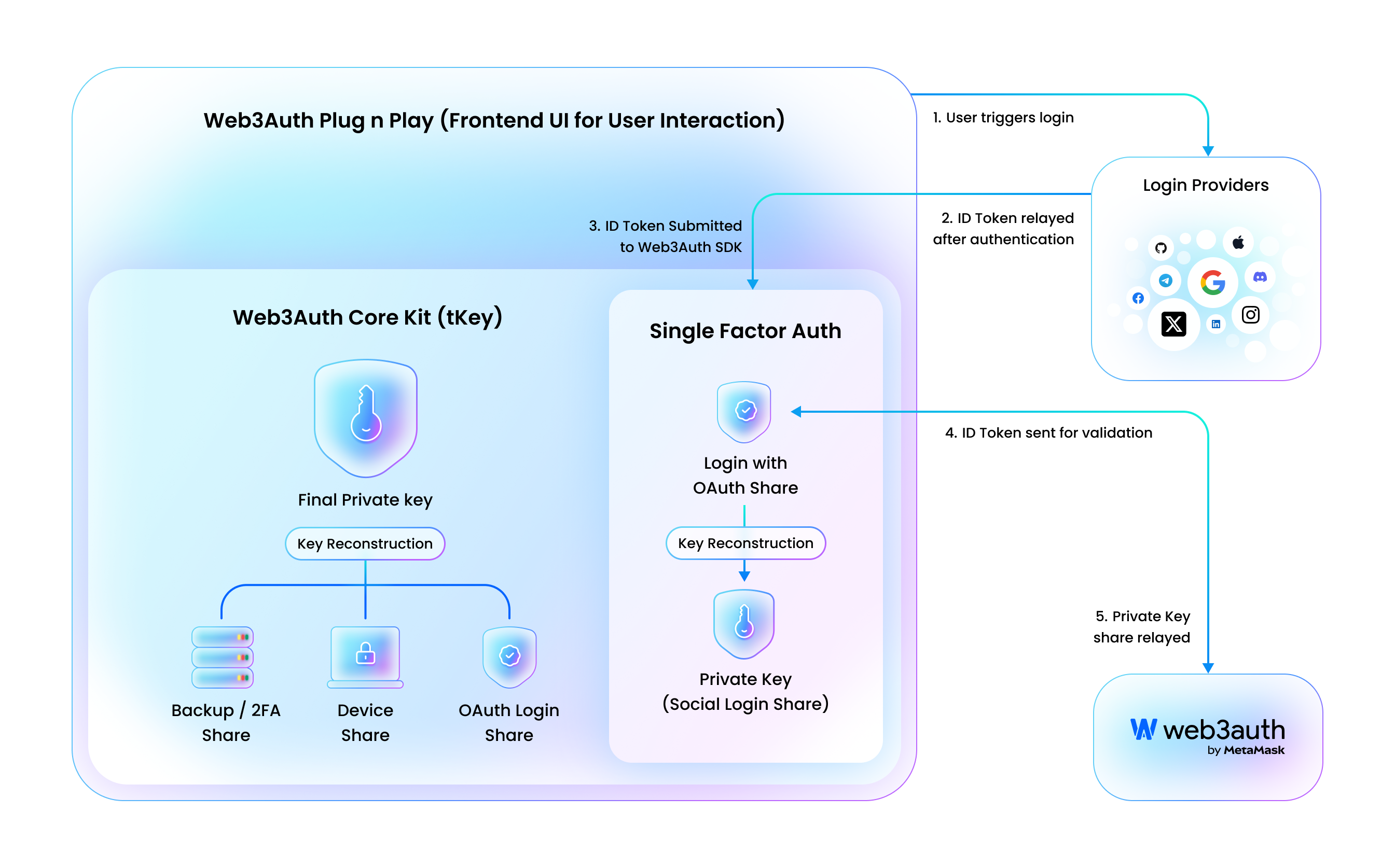
MetaMask Embedded Wallets includes front-end SDKs that run in your app and coordinate OAuth sign-in with the Embedded Wallets network. You use these SDKs to authenticate a user, retrieve the key material required for that user, and create a client that can sign requests on the user's behalf.
The SDKs are now branded as MetaMask Embedded Wallet SDKs (formerly Web3Auth Plug and Play SDKs).
Package names and APIs remain Web3Auth (for example, Web3Auth React SDK), and code snippets may reference web3auth identifiers.
At a high level, the flow includes:
- Your app: Starts OAuth sign-in with the selected login provider.
- Login providers: Authenticates the user and returns an ID token.
- Embedded Wallet SDK: Submits the ID token for validation and requests the user's OAuth key share.
- Core kit (tKey): Combines key shares to recreate the user's signing key.
- Embedded Wallets network: Validates tokens and returns the required key share.
- Your app: uses the SDK-provided client to create a wallet provider and sign requests on the user's behalf.
The following diagram summarizes the login flow and shows how the SDK components interact with the integrating app and the Embedded Wallets network.
Wallet management infrastructure
The wallet management infrastructure improves security by splitting a user's wallet into multiple key shares, which avoids direct exposure of seed phrases. Users combine OAuth sign-in, trusted devices, and other recovery factors to access and manage their cryptographic keys. The infrastructure is designed so that no single party holds the full private key.
To create an OAuth login share, users interact with the Embedded Wallets network. Key generation uses a threshold process that requires multiple participants to contribute shares. This helps keep wallets non-custodial, because no single party (including MetaMask or the login provider) can use a single share to control the wallet.
The infrastructure uses Shamir's Secret Sharing to split and recover wallet keys. For more details, see Wallet management infrastructure.